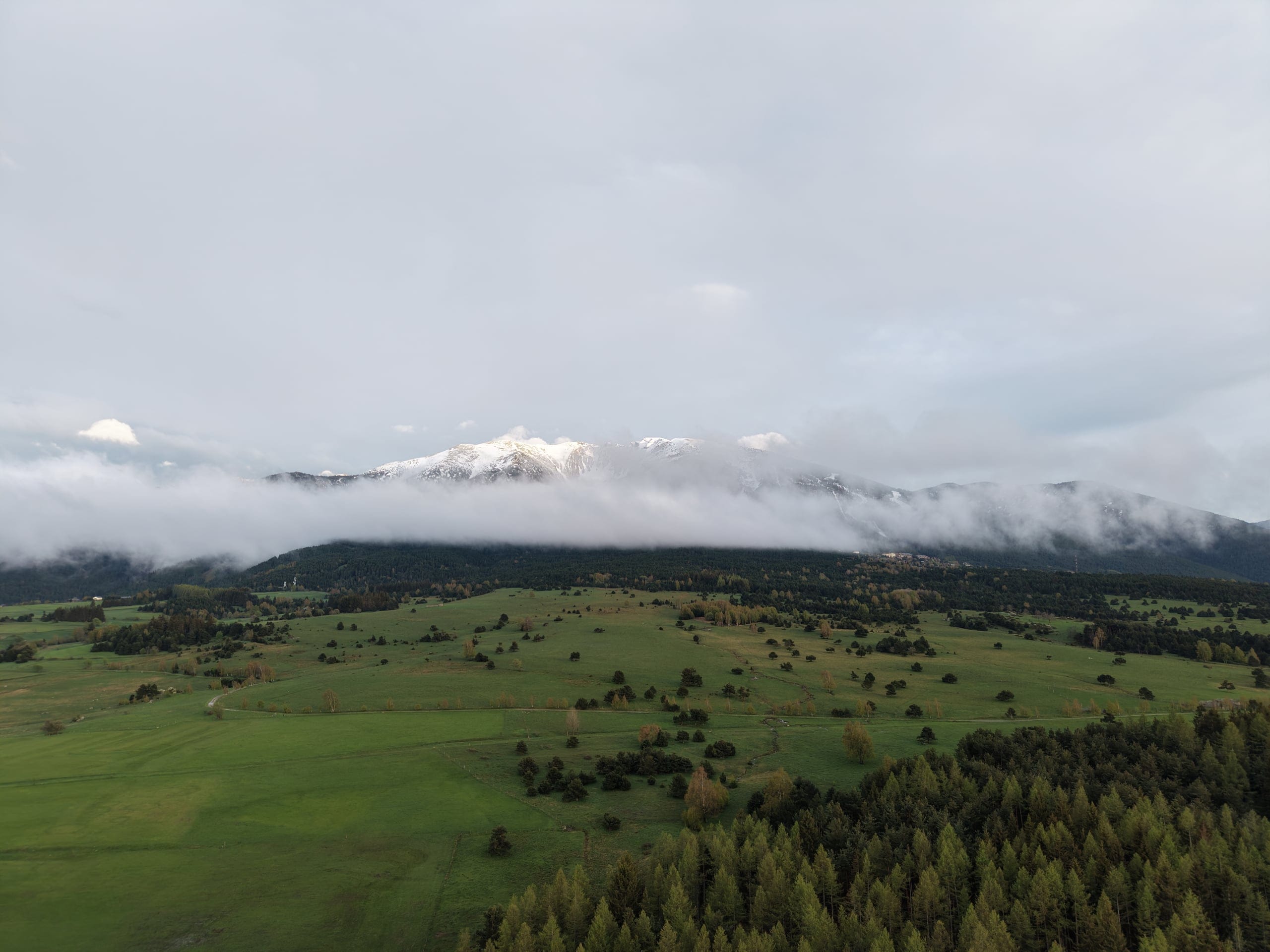

Lac des Bouillouses is one of the largest lakes in the French Pyrenees. It was created by a dam on the Têt, brought into service in 1910 to generate electricity for the Yellow Train. All around it, the Carlit massif has 27 tarns and mountain lakes, and the Pyrénées-Orientales department maintains 60 km of waymarked trails there.
From the hotel, it’s 16 km and about 25 minutes by road to the dam. But in summer, during the day, the lake road is closed to cars: you park at the Pla de Barrès and take the shuttle bus up.
Published on 25 November 2026
Getting up to the lake in summer
In summer, an order issued by the department closes the lake road, the D 60, to cars during the day; it can even close earlier in the morning, as soon as the car park at the foot of the dam is full. You then leave your car at the Pla de Barrès car park (600 spaces, outside the protected site). This is where the department’s shuttle buses start: they go up to the dam with six request stops, and the ride back down is free.
In 2026, the shuttles ran at weekends in June and September, and every day from 4 July to 30 August. Dates and times change every year: check the department’s website before you set off.
Without a car: during the same periods, liO bus 564 runs from Mont-Louis - La Cabanasse station, connecting with the Yellow Train, and from Mont-Louis to the Pla de Barrès car park. The station is 2.5 km from the hotel.
On the shuttles, dogs must wear a muzzle for the whole journey, with no more than five per vehicle. The buses can’t take wheelchairs: people with reduced mobility can drive up in their own car, following a shuttle.
From Font-Romeu, the Calme Nord chairlift usually took you towards the lake. It was dismantled in 2026; its replacement has been announced for summer 2027.
The rest of the year
Outside the shuttle periods, you can drive up to the dam, on a narrow road from the Pla de Barrès. Park at the Pla de Barrès or below the dam, never on the verges.
In winter, snow closes the D 60 at the Pla des Avellans. You then reach the lake on foot or, better still, on snowshoes, in about 1 hr 30.
A lake made for the Yellow Train
In 1902, the French State decided to build a dam to regulate the flow of the Têt. The access road, today’s D 60, was completed in 1904, then the dam was built from 1904 to 1910, only during the summer months. This masonry gravity dam, about 25 m high and 364 m long, holds back more than 17 million m³ of water.
Brought into service in 1910, it first generated electricity for the Yellow Train. Today it is operated by the Société hydro-électrique du Midi (SHEM), and its water can be released to irrigate the Têt valley.
On the site, the Spanish municipality of Llívia owns land where it grazes its herds, as provided for by the Treaty of the Pyrenees.
Walks around the lake
A few waymarked routes, with the distances, times and difficulty levels given by the department:
- The Borda trails, family walks starting from the Pla de Barrès car park: along the banks of the Têt (4.1 km, 1 hr 10), through the Calvet forest (3.3 km, 1 hr 05), or the loop that combines the two (7.4 km, 2 hrs 10). Easy.
- The Pradella loop, starting from the information point at the dam: 4 km, 1 hr 15, easy.
- The Carlit lakes, a loop from the Bones Hores hotel: 9 lakes in 6.5 km and 2 hrs 20, or 12 lakes in 9.7 km and 3 hrs 30, moderate to difficult. Most of the effort comes in the first half hour.
- The Carlit, 2,921 m: 3 hrs 20 up to the summit, difficult. This is a high-mountain route, for people with at least some mountain experience; the steep final stretch means using your hands.
On site
The GR 10 passes through the Bouillouses. On the site, you can sleep and eat at the Bouillouses refuge, the Bones Hores hotel or the Auberge du Carlit.
In summer, the department offers free hikes with a mountain leader, to discover the local wildlife and plants; in 2026, on Tuesdays and Thursdays, from 14 July to 27 August. Climbers will also find marked climbing sites, with routes graded from 4 to 8a+.
Rules of the protected site
The lake and its surroundings have been a protected site (site classé) since 24 June 1976, in the heart of the Pyrénées Catalanes Regional Nature Park, and are part of the Natura 2000 network. On site:
- Dogs stay on a lead across the whole site: leave the herds in peace.
- Camping is not allowed. Bivouacking is tolerated, provided you take your tent down during the day.
- Fires are only allowed at the designated spots (the Borda, the Pla des Avellans, below the dam), and are banned everywhere when the fire risk is high or the wind is strong.
- The lake is a reservoir: the Regional Nature Park reminds visitors that swimming is prohibited in reservoir lakes.
- Don’t pick the flowers, keep your distance from wild animals, and take your rubbish home.
- Motorhomes can park at the Pla de Barrès, but sleeping there is not allowed.
- Fishing on the reservoir is subject to specific rules: check with the Pyrénées-Orientales fishing federation.
Access, shuttles and rules
- The Bouillouses protected site: access, shuttles and outings (Pyrénées-Orientales department) (new tab)
- Practical information and regulations (Pyrénées-Orientales department) (new tab)
- liO bus 564 from La Cabanasse station and Mont-Louis (new tab)
- The lake live: Pyrénées-Orientales department webcam (new tab)
- The Bouillouses protected site (Pyrénées Catalanes Regional Nature Park) (new tab)
- Fishing in the Pyrénées-Orientales (fishing federation) (new tab)