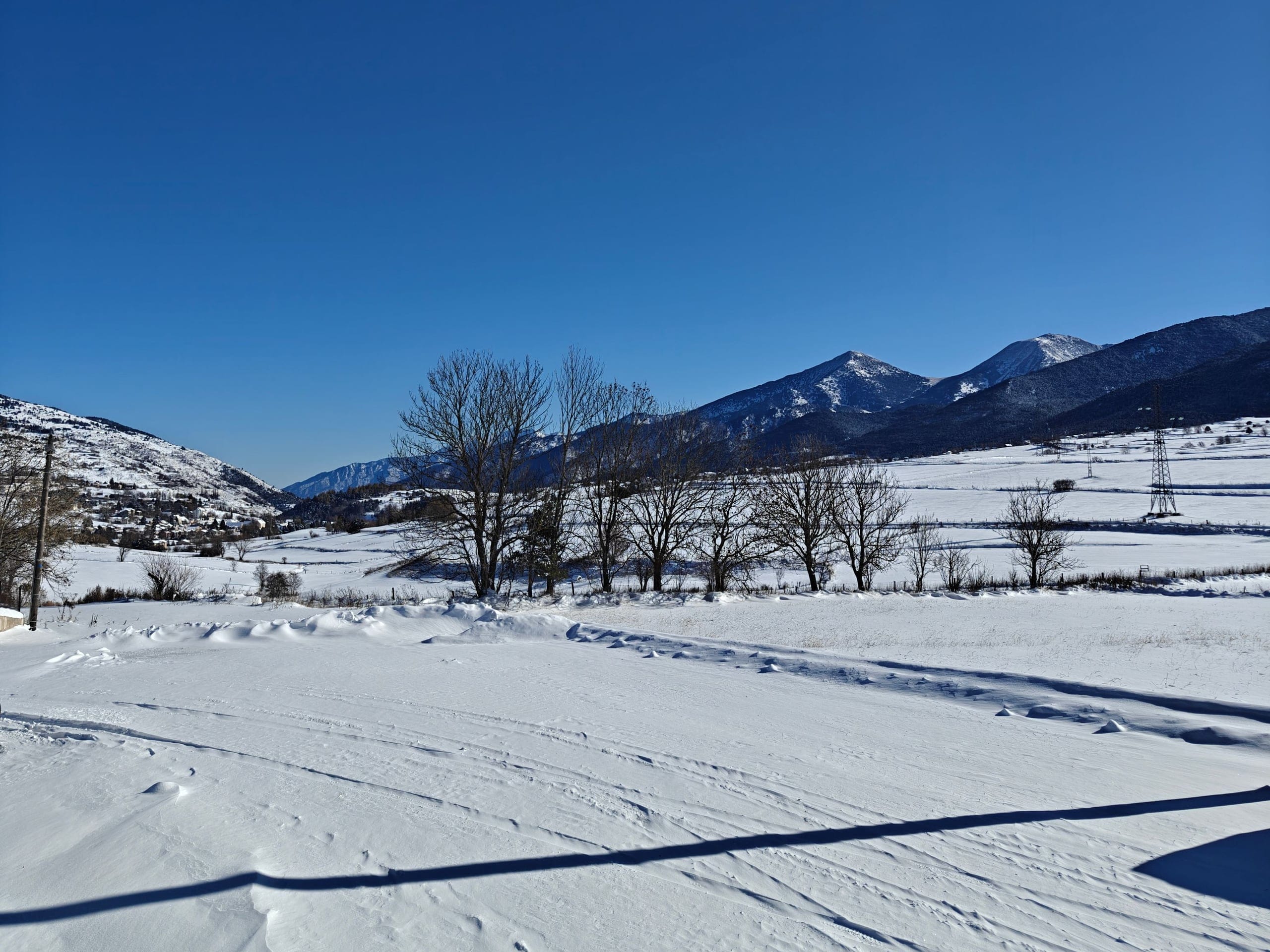
Mont-Louis is a new town, built from scratch between 1679 and 1681 to guard the border, at 1,600 m above sea level. Since 2008, its ramparts and citadel have been a UNESCO World Heritage Site, along with other fortifications by Vauban.
From the hotel, it’s 4 km and five minutes by road. You can explore the town freely all year round; the citadel, still occupied by the army, can only be visited with a guide, booked in advance.
Published on 25 November 2026
A new town, built in two years
The Treaty of the Pyrenees was signed in 1659, but the French part of Cerdanya was still unfortified, and the Spanish fortress of Puigcerdà threatened the border. Louis XIV approved the creation of a new stronghold. On 17 March 1679, Vauban came to survey the chosen site, at 1,600 m above sea level, where the Têt valley, the Capcir, the Aude valley and the Col de la Perche meet.
The stronghold was built from 1679 to 1681 and bears the king’s name. It is laid out as two squares, one above the other on the slope: the citadel, with four bastions and three demi-lunes, and the town, inside a wall with three bastions, including the Perche bastion. Vauban also planned a lower town and a redoubt, which were never built; as for the houses, they only went up fifty years after the inauguration.
In 1793, a battle against the Spanish was fought at the Col de la Perche, where the hotel stands today.
A UNESCO World Heritage Site
On 7 July 2008, UNESCO added the Fortifications of Vauban to the World Heritage List: twelve groups of sites along France’s borders, including the ramparts and citadel of Mont-Louis. According to the Réseau des sites majeurs de Vauban, Mont-Louis is the first fortification system adapted to the mountains.
Unusually, all its sentry turrets, all its drawbridge gates, its two churches and its two wells have survived intact. The town ramparts have been listed as a historic monument since 1922, and those of the citadel since 2021.
The town, free to explore
You enter the town through the Porte de France and its drawbridge, its only entrance, on the south side. Information panels guide you around the streets, and walking around the ramparts shows the stronghold in its mountain setting: the department’s “Fortifications de Mont-Louis” route sheet suggests a 1.1 km loop, about 40 minutes, starting from the tourist office.
Step inside Saint-Louis church, built from 1733 to 1737 and dedicated to Saint Louis, Louis XIV’s ancestor.
The citadel, with a guide
Since 1964, the citadel has housed the Centre national d’entraînement commando - 1er Choc, the national commando training centre: it’s one of the last military units based in a Vauban fortification. It can only be visited with the tourist office’s guide. For the tour:
- Booking is required, at least 24 hours in advance: the citadel is a military zone.
- Each adult must show an original, valid ID document.
- Photos and videos are not allowed inside.
- The tour is in French, with information sheets in English and Spanish.
- The tourist information office may be closed during citadel tours: book in advance.
The convicts’ well
The tour takes in the convicts’ well, dug about 28 m into the rock, 11 m of which are water. A soldier, preferably one being punished, turned the great wheel, the “squirrel cage”, that drew the water up. Yet there were never any convicts at Mont-Louis.
It’s one of the last three original wheels of this kind in France, along with those at the Besançon citadel and Mont-Saint-Michel.
The solar furnace
In 1949, on the initiative of Félix Trombe, Mont-Louis received a 50 kW solar furnace: the world’s first double-reflection solar furnace, where the power of the sun can push temperatures above 3,000°C. It later served as the model for the large Odeillo solar furnace, in Font-Romeu, where the CNRS laboratories moved in 1968.
Moved to the south bastion in 1975, the Mont-Louis furnace is now used for educational purposes. The guided tour lasts about 45 minutes, with demonstrations when the sun and the weather allow. The site is accessible to people with reduced mobility; bring sunglasses.
Getting there
Park at the Remparts car park, outside the town at the foot of the walls (access via the D 66): the car park inside the walls is mainly for residents. Without a car, the Mont-Louis - La Cabanasse Yellow Train station is 800 m from the town.
Tickets for the guided tours are sold at the tourist information office, 13 boulevard Vauban. Days, times and prices are published on the tourist office website.
Tours, bookings and opening times
- Guided tours of the citadel and the solar furnace (Mont-Louis tourist office) (new tab)
- Tourist information office, station and car parks (new tab)
- Mont-Louis, a major Vauban site (Réseau Vauban) (new tab)
- The Fortifications of Vauban on the World Heritage List (UNESCO) (new tab)
- The Mont-Louis solar furnace (Tourisme Pyrénées-Orientales) (new tab)
- Walking around the fortifications (rando66, Pyrénées-Orientales department) (new tab)